

German English
01. April 2026
Italy
Rhythmic Gymnastics
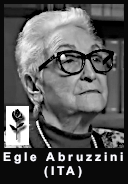
Egle Abruzzini, the legend of rhythmic gymnastics and world sports, has passed away
 |
|
*1936 - +2016 |
Egle Abruzzini, the legend of rhythmic gymnastics and world sports, has passed away. She was 90 years old. Egle Abruzzini chaired the Technical Committee of the International Gymnastics Federation from 1984 to 2008. She became one of the key figures in rhythmic gymnastics. Thanks to the many years of work by the Italian specialist, this sport has achieved incredible progress. The gymnasts' routines became more intense and technically complex — the number of difficult and signature elements increased exactly during her tenure on the international stage. Egle was known as a person of very strict moral principles, uncompromising, with an iron will and a constant pursuit of justice. These qualities helped her perform her professional role with great dignity.
When Abruzzini was born 90 years ago on 1 March 1936, the sport was still so conceptual it was simply known as “modern gymnastics.” The first recorded competition in what would become known as Rhythmic took place in 1937, about the time young Abruzzini was learning to walk. She and the sport grew up together, and Abruzzini’s life remained intertwined with it.
Rhythmic Gymnastics shaped Professor Egle Abruzzini’s career trajectory, and she in turn molded it into the Olympic discipline adored by millions today.
Egle Abruzzini chaired the Technical Committee of the International Gymnastics Federation from 1984 to 2008. She became one of the key figures in rhythmic gymnastics. Thanks to the many years of work by the Italian specialist, this sport has achieved incredible progress. The gymnasts' routines became more intense and technically complex — the number of difficult and signature elements increased exactly during her tenure on the international stage. During this time, Alina Kabaeva also became the Olympic champion.
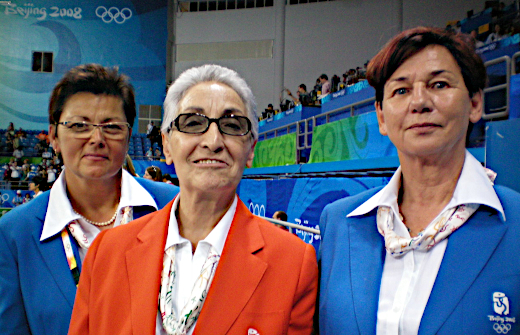
Egle ABRUZZINI (ITA; middle) as Olympic Chief Referee in Beijing 2008,
with the international judges Birgit Guhr (GER; links) und Gilberte Gianadda (SUI)
.
Egle was known as a person of very strict moral principles, uncompromising, with an iron will and a constant pursuit of justice. These qualities helped her perform her professional role with great dignity.
Egle Abruzzini (ITA) spent her long life tirelessly working for the betterment of Rhythmic Gymnastics.
When Abruzzini was born 90 years ago on 1 March 1936, the sport was still so conceptual it was simply known as “modern gymnastics.” The first recorded competition in what would become known as Rhythmic took place in 1937, about the time young Abruzzini was learning to walk. She and the sport grew up together, and Abruzzini’s life remained intertwined with it.
An early graduate of Rome’s Higher Institute of Physical Education, Abruzzini moved from Rome to Urbino in 1961 intending to teach Gymnastics and dance. The first World Championships in Rhythmic Gymnastics were held two years later. During the course of the 1960's the still-developing sport captured Abruzzini’s imagination, and her interest and involvement increased until she was the one guiding the Italian Gymnastics Federation as its in-house Rhythmic expert.
It wasn’t long before her talents and drive elevated her to the international federation, where Rhythmic had gained a foothold. During the next several years, she dedicated her considerable energy to organising teaching academies, helping train judges, and becoming a steady hand on the committees that developed the apparatus and competition rules.
In 1980, Abruzzini was elected to the then-International Gymnastics Federation’s Rhythmic Gymnastics Technical Committee with a mandate to take the sport into the Olympics. Four years later, Rhythmic made its debut at the Los Angeles Olympics. Abruzzini emerged from the Games as Technical Committee President, a position she would hold for the next quarter century.
While on her watch Rhythmic flourished spectacularly over the course of seven Olympic Games, Abruzzini herself changed little. Within the sport, she advocated for instilling strong fundamentals and not overtraining the body. Easily spotted with her short haircut, wide smile and kind word for everyone she met, she was beloved by colleagues to the end of her life. Her final public words, posted on her Facebook page just before her death at the end of March, were full of characteristic zeal and grace.Abruzzini was preceded in death by her husband, the philosopher Livio Sichirollo, and is survived by a daughter, Silvia, and a son, Roberto.
* Source: World Gymnastics
|
|
|
 |

- Partner of GYMmedia -

***
WCh RG, Izmir2014
(Summary, all-around)
***
► Review: WCh 2013, Kiew
***
* past events ...:
♦♦♦
Review: ECh 2013, Vienna
FIG-Review:
Olympic Games 2012
.

♦♦♦

♦♦♦

♦♦♦

♦♦♦

♦♦♦